Coming soon
AI-Proof Your Business
A Playbook for AI Security, Governance, and Trust
Get launch updates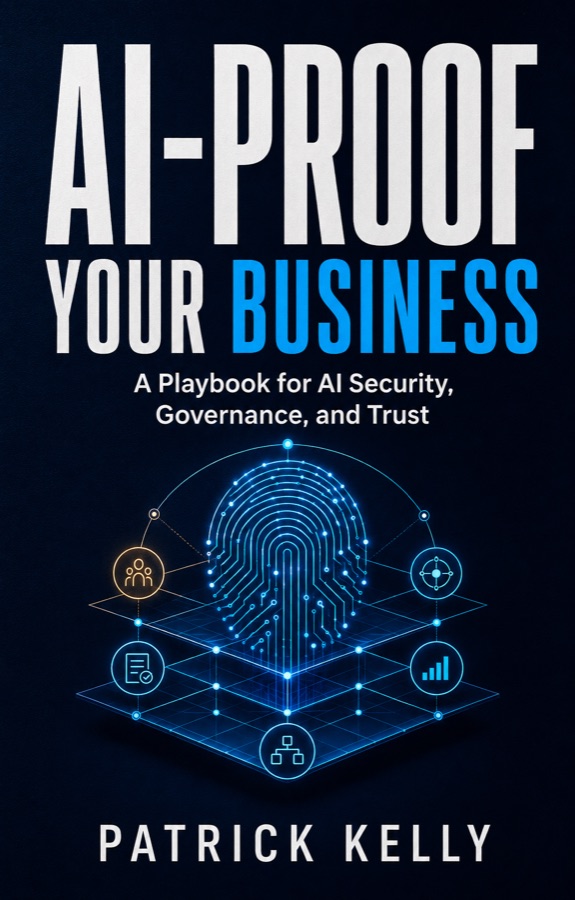
A Playbook for AI Security, Governance, and Trust
Get launch updates
Why this book
Trust is not a feeling. Trust is something you should be able to prove.
Your organization already has two AI strategies: the official one that lives in policy documents, and the real one that lives in browser tabs, pasted spreadsheets, unapproved plugins, and agents whose original author moved on. If an incident landed tomorrow — or an auditor, regulator, or reporter asked — could you produce a current list of every AI system in production, the data it touches, and the human who owns it?
The first job is to make the invisible visible. The second is to build the architecture, governance, and evidence that answer the only question that matters after something goes wrong: who did what, when, and under what authority.
What’s inside
The book's spine: a person practices trust calibration by asking how much weight an AI output deserves before acting on it. An organization practices it by building that question into its architecture, governance, and culture, so…
Shadow AI is born from pressure, not malice, and data leaves governance before anyone notices. Inventory is named as the single highest-leverage control: until an organization has an accurate, current picture of where AI is being…
A chatbot answers; an agent acts — browsing, calling tools, writing records, sending messages. That shift breaks the old assumption that input is passive data, which is why prompt injection attacks the instruction layer itself.…
Most AI conversations stop at policy, and policy alone is not security. The book's architectural test is whether the organization can answer who did what, when, and under what authority — and it names the four failure modes it…
If trust cannot be measured, it becomes a slogan. Real governance is checkable: a current inventory, classified use cases, retained evidence trails, role-specific training, monitoring and incident response that actually run, and…
The four recurring business mistakes are treating AI as a procurement decision, governance as a one-time document, customer trust as a marketing problem, and the program as something that ends. The alternative is sequenced and…
From the book
The most dangerous AI in a company is often not the most advanced one. It is the one nobody knows is running.
Every organization has two AI strategies: the official one and the real one.
A chatbot answers. An agent acts.
But autonomy without auditability is just deniability with a marketing budget.
A governance function that has never declined a request is not governance. It is decoration.
Real governance is boring in the way seat belts are boring.
Contents
What makes it different
The author
Trust is not a feeling. Trust is something you should be able to prove.